
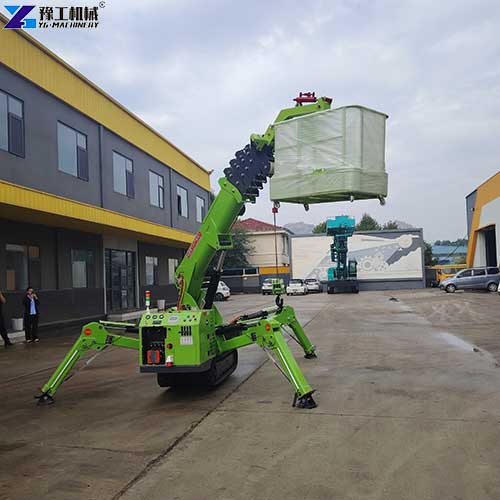

When an American construction contractor took on a glass installation project in a busy commercial area, the job looked simple on paper. The building was already completed, the glass panels had arrived, and the installation team was experienced. But there was one major problem: how could they lift several heavy glass panels into position when there was almost no room for a conventional crane? The project was located in a developed urban area. The building stood close to neighboring properties, the access road was narrow, and part of the surrounding area had already been finished with concrete paving. The customer needed a crane that was powerful enough to lift heavy glass, compact enough to enter a narrow site, stable during lifting, easy to reposition, and suitable for working in a restricted area. After comparing several options, the contractor decided to purchase a YG 5t mobile spider crane. For the customer, the machine was not simply another piece of construction equipment. It became a practical solution to a difficult lifting problem.
Want More Case Studies? Contact YG For Customized Services
Parameters of YG Spider Crawler Crane
| Model | YG-3 | YG-5 | YG-8 | |
| Specification | 3t | 5t | 8t | |
| Maximum working radius | 8.83m×0.15t | 14m×0.5t | 16.5m | |
| Maximum above-ground head | 9.9m×0.7t | 16.8m | 18m | |
| Winch device | Hook Speed | 0-8m/min(4 rope) | 12m/min(4 rope) | 12m/min(4 rope) |
| Rope diameter | φ8mm×45m | Φ11mm×80m | Φ11mm×80m | |
| Telescopic system | Boom Type | 5-section boom, pentagonal structure | 5-section boom, pentagonal structure | 5-section boom, pentagonal structure |
| Boom Length/Time | 3.1m-9.2m/20sec | 12.3m/54sec | 12.3m/54sec | |
| Up and down | Boom Angle/Time | 0°~78°/13sec | 0°~78°/13sec | 0°~78°/13sec |
| Slew system | Slew Angle/Speed | 0-360°continuous/60sec | 0-360°continuous/38sec | 0-360°continuous/38sec |
| Traction system | Walking Way | Hydraulic motor drives | Hydraulic motor drives | Hydraulic motor drives |
| Walking Speed | 0~2.5km/h | 0~2.5km/h | 0~2.5km/h | |
| Grade Ability | (25°)36% | (25°)36% | (25°)36% | |
| Operating system | Operation type (Boom/outrigger) | Manual operation, manual walking(remote control option) | Manual operation, manual walking(remote control option) | Manual operation, manual walking(remote control option) |
| Operating characteristics | Manual operation, remote control | Manual operation, remote control | Manual operation, remote control | |
| Transport parameters | L*W*H(mm) | 2950*980*1560 | 5000*1500*1900 | 5000*1600*2180 |
| Total weight(kg) | 2700 | 6200 | 7200 | |
Want More Case Studies? Contact YG For Customized Services


Meet the Customer: An American Contractor with a Growing Business
The customer was a medium-sized construction and installation company based in the United States. The company had approximately 30 employees and mainly served commercial construction projects in its local market. Its core business included glass curtain wall installation, window installation, steel structure work, equipment handling, building renovation, and commercial maintenance. The company had previously used rental cranes for larger projects.
However, the project team noticed a recurring problem. Large cranes were powerful, but they were not always convenient for smaller and more complicated sites. Sometimes the crane could not enter the site. Sometimes the setup area was too small. Sometimes the transportation and mobilization costs were too high.
The project manager explained:
“We did not need the biggest crane. We needed the right crane.”
That sentence became the starting point for the equipment selection.
The Problem: The Glass Was Heavy, but the Site Was Tight
The project involved installing large glass panels on the exterior of a commercial building.
Some of the panels weighed around 1,000–1,500 kg, and several panels needed to be lifted from the ground to the installation position. The biggest challenges were not simply the glass weight.
- Limited Working Space. The building was surrounded by existing structures and finished surfaces. There was not enough room for a conventional large mobile crane to operate comfortably.
- Narrow Access. The entrance to the working area was relatively narrow. The customer needed a machine that could pass through the available access route.
- Frequent Repositioning. The installation team did not need to lift only one panel from one fixed location. The lifting position had to change as the installation progressed.
- High Rental Costs. Renting a large crane for every stage of the project could significantly increase the project budget. The customer wanted a machine that could be used on multiple projects after this job was completed.
Want More Case Studies? Contact YG For Customized Services


Why Did the Customer Choose a 5-Ton Spider Crane?
After discussing the project requirements, the customer focused on a 5-ton spider crane. The main reason was the balance between lifting capacity and compact dimensions. The customer did not want a machine that was unnecessarily large. Instead, the machine needed to provide enough capacity for the actual lifting requirements while remaining easy to transport and position. The customer also compared several configurations and paid particular attention to:
- Rated lifting capacity
- Working radius
- Boom reach
- Machine dimensions
- Outrigger configuration
- Ground pressure
- Transportation requirements
- Safety systems
- After-sales support
This evaluation helped the customer avoid choosing equipment based only on the maximum lifting capacity.
The Lifting Process: From Ground to Glass Wall
The installation team used the crane together with suitable glass lifting equipment.
The basic workflow was straightforward.
- Position the Crane. The crane was moved to the planned lifting position.
- Deploy the Outriggers. The outriggers were extended to provide a stable working base.
- Connect the Glass. The glass panel was connected using appropriate lifting equipment.
- Lift Slowly. The operator gradually lifted the glass panel while the installation team monitored its movement.
- Rotate and Position. The boom was controlled carefully to move the panel toward the installation area.
- Complete Installation. Once the glass reached the correct position, the installation team secured it to the curtain wall structure.
A Week Later: The Customer Started Seeing the Real Value
The customer originally purchased the machine for one project.
But after several days of operation, the project manager began to see another benefit.
The crane could be used for other tasks on the site.
Besides glass installation, the team used it for:
- Window frame handling
- Small steel components
- Building materials
- Equipment positioning
This made the crane more useful than expected.
The contractor realized that purchasing the machine could provide value beyond a single project.
Project Results: What Changed After Using the Crane?
The customer tracked several project indicators before and after using the new lifting equipment.
According to the customer’s project estimate:
Installation Productivity Increased by About 25%
The team completed the glass lifting and positioning work approximately 25% faster than their previous manual and rental-equipment workflow.
The improvement came from reducing repeated material handling and minimizing crane setup interruptions.
Project Schedule Was Reduced by About 6 Days
The original plan allowed approximately 24 working days for the relevant lifting and installation stage.
The actual process was completed in about 18 working days.
That represented a saving of approximately 6 working days.
Labor Pressure Was Reduced
The contractor estimated that approximately 2–3 workers who would otherwise have been heavily involved in manual material movement could be reassigned to installation and finishing work.
Equipment-Related Costs Fell by About 18%
Compared with the customer’s previous approach of renting larger lifting equipment and arranging repeated mobilization, the overall lifting-related cost was estimated to be approximately 18% lower.
These figures are project-specific estimates and can vary significantly depending on load, working radius, site conditions, labor costs, and local rental rates.
Want More Case Studies? Contact YG For Customized Services

The Customer’s Experience with a 5T Small Spider Crane
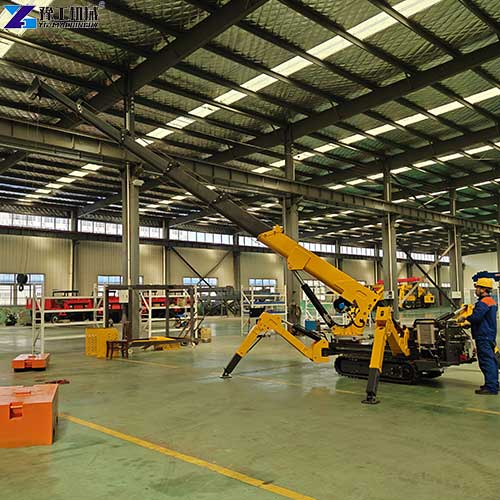
For this contractor, the 5t small spider crane became particularly useful because many of its projects were not huge construction sites.
The company often worked in:
- Urban areas
- Existing commercial buildings
- Narrow construction zones
- Renovation projects
- Finished properties
These projects require a different type of lifting equipment.
The contractor needed something smaller than a traditional mobile crane but more capable than simple manual lifting tools. The spider crane filled this gap.
Customer Feedback: What Did the American Contractor Say?
After completing the project, the customer shared several comments about the machine.
About Mobility
“The compact design made it much easier to work in areas where our previous crane could not comfortably operate.”
About Productivity
“The lifting process became much more organized. The installation crew spent less time waiting for materials.”
About Versatility
“We originally bought it for glass installation, but we have already found several other jobs for it.”
About Future Projects
“We expect to use this crane for window installation, steel components, equipment handling, and renovation projects.”
Overall Impression
“For our type of work, the combination of size and lifting capacity is more important than simply having a larger crane.”
Want To Quickly Launch A New Project? Contact YG For Customized Services
The American contractor originally purchased the machine because one glass curtain wall project created a difficult lifting problem.
But after using it, the company discovered much more value.
The crane helped the team:
- Improve lifting productivity by about 25%
- Reduce the relevant project stage by approximately 6 working days
- Reduce lifting-related costs by an estimated 18%
- Reduce heavy manual handling
- Work more comfortably in restricted areas
- Take on additional lifting applications
Most importantly, the customer no longer saw the crane as equipment for only one project. It became part of the company’s long-term construction toolkit.
For contractors looking for a solution for glass installation, renovation, equipment handling, or other restricted-access lifting work, a 5t mobile spider crane can be worth considering when its load chart and working radius match the project requirements.
Have a similar project? Tell us your maximum load, lifting height, working radius, site access width, and ground conditions. We can help you select a suitable spider crane configuration and provide a practical solution for your project. Welcome to contact YG anytime.